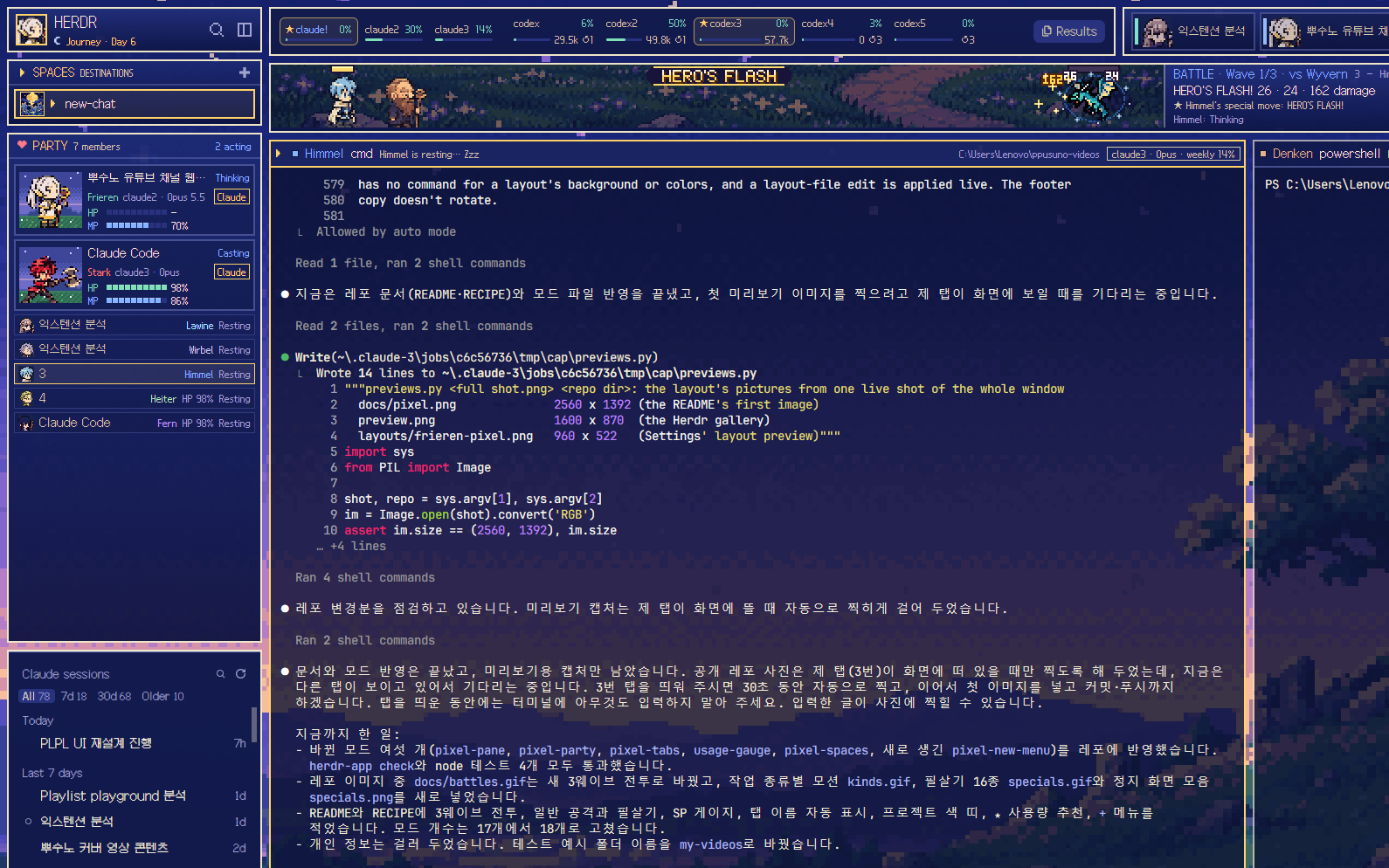
I love herdr desktop
For the past few weeks, I have been trying multiple agent orchestration apps. I was previously on herdr-tui but felt like it was too limited in the set of features it offered. So I tried Orca and T3 Code, two of the most famous orchestrators.
Orca and T3 Code
I really like having multiple homeserver running at all times, this allows me to have my agents independent running independently with me having the freeding to steer them confortably from my desktop or on the go on my phone.
And that's where herdr-tui stops being the tool for the job and where I search for alternatives. Orca and T3 code solve that well enough, with T3 code having load balancing features, local simulators,... But you just get overwhelmed with the amount of unecessary stuff that's already there and decided for you.
I just wanted something to orchestrate my agents and have them be aware of the layer of orchestration at their disposal. Orca and T3 were just bloated with unecessary features and were too rigid to add the features I actually wanted. It's so weird that we have those vibe coded orchestrator that don't make it easy for you to vibe code your own features on top.
Herdr
That's were the new herdr desktop comes in and it's so clever I love it.
Herdr doesn't try to overcomplicate stuff at all, it comes with herdr core, a cli that manages your agents and shells. Herdr desktop is just a UI drawn on top that allows you to see what's happening and manage it.
Herdr does not try to have all that unecessary vibe coded bloat with load balancing, qr code phone pairing and ... You have tailscale, it connects to your other machines via ssh and that's it.
So right now we have a very simple orchestrator but what makes it so good? Well you can actually vibe code any missing feature you want, herdr desktop was planned out to make this easy and reliable.
I don't need a load balancer, I don't need an android emulator, I don't need qr code phone pairing,...
But I want a tab to manage which skills and mcp servers are currently enabled in claude and I can vibe code that
in one prompt using opus 5.5 in my .config/herder-app folder.
Just try it, it's amazing, you can turn it in anything you want, add any feature you want, it's so simple.
How does it work?
For reference, I had a swarm of claude fable 5.2 and opus 5.5 agents run research on the subject, give the results to a gemini-neon-4 writter that was then reviewed by claude agents again. The full report is here for anyone who want's to go deep on this: herdr-desktop-app-research. What comes bellow is my own understanding of it all.
Herdr was built to be highly modular from the ground up. As said before it has two layers, the core and the app. Here we will talk about the app. Essentially: The layout is just a json file describing where elements can go. The elements (anything, such as the sidebar) are written in typescript files named mods.
An AGENTS.md file at the root of the config folder informs the Agent that unlike traditional software, the UI and fonctionality of the app can be completely modified from the files in this folder.
Now for obvious reasons, there are still a few core pieces that are not javascript mods such as the terminal emulator window.
Reflexion on software in general
No software can suit everyone perfectly. I think that herdr got the perfect solution: Ship something minimal that has exactly what's needed to turn it into anything you want. That idea of software is starting to spread and I am all for it. I haven't tried omarchy in a while but I feel like that's also their philosophy.
Everything is slop anyways, I don't believe that windows source code is any better than plugins people vibe code for omarchy.
There is still something beautiful in well thought, human written code such as the suckless tools that I used to have running on my thinkpad long before the slop apocalypse. And the standard LLM written typescript code is just horendous to look at for me. But code does not matter anymore, if the LLM is trained to write robust typescript programs, I don't care that it looks ugly, as long as it works reliably.